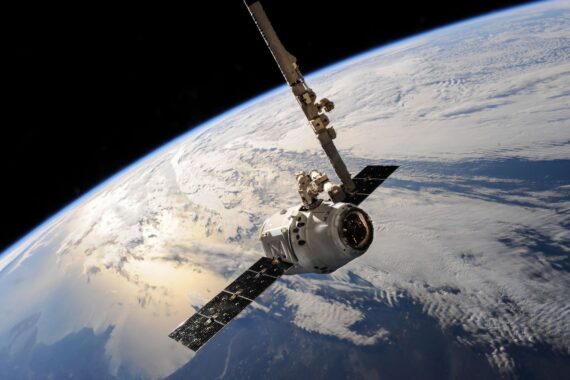
Google has taken a significant step toward moving AI computing into orbit. On November 19, 2026, the company announced an agreement with Blue Origin: the New Glenn rocket will carry the first dedicated heavy-lift flight for Project Suncatcher. The target is the first quarter of 2029.
Under the agreement, solar-powered satellites carrying Google’s Tensor Processing Unit (TPU) chips will be placed in orbit synchronized with the Sun. Each satellite is expected to deliver computing power on roughly the scale of a data center rack.
Heavy-lift capacity with New Glenn
Blue Origin’s New Glenn rocket can carry 45 tons to low Earth orbit and more than 13 tons to geostationary transfer orbit. Its seven-meter payload fairing provides twice the volume of the smaller five-meter class, and its reusable first stage is designed for at least 25 flights. Jordan Charles, Blue Origin’s senior vice president of New Glenn, said the rocket’s heavy-lift capacity and spacious fairing give customers the flexibility to establish new capabilities in orbit. For Suncatcher, this capacity means a multi-satellite deployment that goes beyond the single-prototype stage.
From prototype to satellite network
Google unveiled the Project Suncatcher prototype in September 2026. On the prototype satellite launched on October 1, 2026, the mainboards and TPU racks were up and running by October 30, and early machine-learning tests were conducted. The Gemma 4 model on board generated a haiku; Google described it as the first AI response from a data-center-class TPU in orbit. After thermal stress and radiation testing, the plan calls for reaching the milestone of two interconnected satellites in 2027.
The energy rationale and engineering challenges
According to Google, satellites in low Earth orbit can access sunlight almost continuously and generate up to eight times more solar power than on Earth. Future designs aim to place dozens of TPUs on each satellite and establish high-bandwidth laser communications between spacecraft. But chips can’t be cooled with airflow in a vacuum; engineers tested heat pipes and radiators in a thermal vacuum chamber. Laser links between moving satellites also require precise knowledge of each spacecraft’s position relative to its neighbors.
The agreement opens the way for a larger research deployment, but the fundamentals of orbital computing—reliable chips, effective cooling, and seamless satellite-to-satellite communications—still need to be established. These tests will determine whether Suncatcher can evolve from individual machines into a networked machine-learning system.
Source: Unite.AI

Share your experience
Bir sorunun, farklı bir çözümün veya eklemek istediğin bir notun var mı? Giriş yapmadan da yazabilirsin.