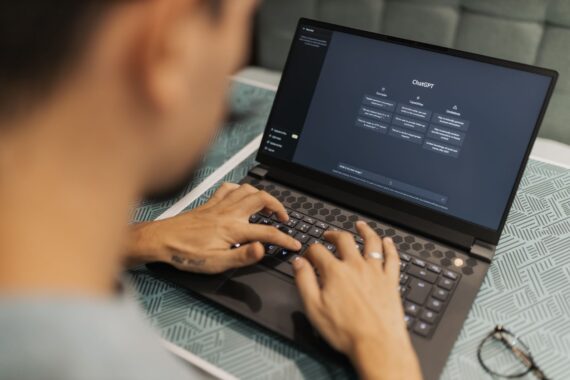
Thinking Machines Lab introduced its new open-weight model, Inkling 2 Mini, on November 20, 2026. The model was designed to run on consumer laptops. It has 26.4 billion parameters in total and a memory footprint of about 20 GB. The company released the model’s full weights and an accompanying research model (TML-d24-varloop-research) on Hugging Face.
What the looped architecture changes
Inkling 2 Mini is a Mixture-of-Experts transformer. That means only part of the model is activated for each token. Its 24 layers are grouped into four blocks, each containing six layers. The first and last blocks run once, while the two middle blocks share their weights and run three times. This produces 48 layer applications per token from 24 stored layers. The model has 3.4 billion active parameters.
According to the company’s training comparison, a model without looping takes 7.5% less compute to train, but requires 140% more inference compute to reach the same loss. That’s the rationale for looping: the model can take more internal steps on its own without written reasoning traces.
Where it runs
The model is available for inference and fine-tuning through Tinker, and you can also chat with it in Tinker Playground. Locally, it can run with Ollama on Mac systems with at least 32 GB of memory, or with GGUF versions through Unsloth and llama.cpp.
One of the company’s demos stands out: in airplane mode, a MacBook Pro ran the model offline and created a playable flight simulator in a few minutes. In another demo, a single offline MacBook ran all 20 residents of Thinkyville, a pixel-art town. In other words, the device itself can host multiple persistent agents locally.
Coding performance and limitations
According to the results shared by the company, the model scores 48.2% on DeepSWE v1.1 and 77.9% on the 51-task SWE-bench Pro v2 Hard evaluation. For comparison, Qwen3.8-27B scores 42.2% and 73.8%, respectively. The company also notes that evaluation setups may vary between models.
The model has some weak points, too. The company says Inkling 2 Mini isn’t the strongest small model for multi-turn conversations or instructions with many constraints: it scores 50.0% on MultiChallenge and 33.4% on ComplexConstraints v1.1. It also trails larger models on reasoning-intensive tests such as CritPt v2 and HLE-Diamond.
A new question for oversight
Looping raises a new debate around monitoring. While conventional models have to put reasoning that requires extra steps into words, a looped model can take some of those steps internally without reflecting them in its generated text. Systems that monitor reasoning by reading that text can’t see reasoning that never makes it into the text. The company says it explored this issue with a separate research model and shared its findings.
The arrival of open-weight models at laptop scale is a practical step for those who want to use AI without relying on the cloud. Inkling 2 Mini’s weights are available on Hugging Face.
Source: Unite.AI


Share your experience
Bir sorunun, farklı bir çözümün veya eklemek istediğin bir notun var mı? Giriş yapmadan da yazabilirsin.