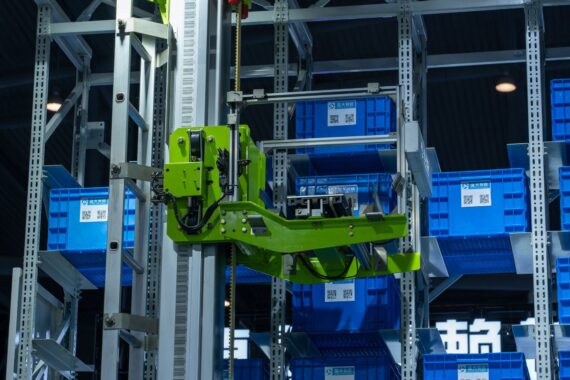
On November 11, 2026, NTT introduced a physics-based world model that evaluates robot motions before executing them. According to the company, in a shelf-loading test with a small robot, the system raised task success from 73.1% to 92.3%. The initial target is baggage loading and unloading at airports.
Baggage handling is a tough area for robots. The shape, weight, and placement of luggage are constantly changing, and traditional control software can’t reliably predict in advance whether a movement will tip the load over or cause a bag to fall. Collecting training data for every possible item isn’t practical either. That’s why NTT is planning field trials with Mujin for baggage handling.
Testing before moving
The model works alongside existing robot control software and adds a prediction-and-evaluation step before movement. Candidate actions come from two sources: a vision-language-action model that turns camera images and language instructions into robot actions, or a motion planner that calculates the control needed to achieve the task goal. For each candidate, the system generates a predicted video, evaluates and scores the likelihood of collision, dropping, and load tipping. The control program then selects the action that appears most likely to succeed.
What the physics control adapter changes
According to NTT, traditional world models do not explicitly represent the physical properties of objects. In generated video, objects can disappear, deform unrealistically, and collision predictions can drift off. These models’ dependence on large training datasets also increases errors in situations not present in the data.
NTT’s physics control adapter estimates each object’s position, orientation, velocity, and mass from video. It then calculates the object’s next motion using the laws of physics and feeds that result into the video generation model. This makes it possible to model objects and motions that were never seen in the training data. The model also outputs the physical quantities behind its prediction, so what the result is based on can be observed from the outside.
Test results and questions that still remain open
NTT measured future-video accuracy on the OBJ3D benchmark, which consists of video frames of synthetic objects colliding. The company says it outperformed conventional methods on the LPIPS metric, which is designed to align closely with human perception; in this metric, a lower value indicates that the prediction is closer to reality.
The announced results, however, are limited to a small robot task and synthetic collision videos. The baggage trials with Mujin will show whether the gains seen in shelf loading carry over to real airport operations. NTT plans to expand the technology into logistics, warehousing, manufacturing, construction, and retail; the goal is to reduce labor needs and increase productivity, but those are not yet verified outcomes. The system will be showcased at NTT R&D Forum 2026 on November 18–20 and November 24–25, 2026.
In short, NTT is adding an intermediate step to the habit of having robots execute movements directly: first simulate with the laws of physics, score the outcome, then execute.
Source: Unite.AI

Share your experience
Bir sorunun, farklı bir çözümün veya eklemek istediğin bir notun var mı? Giriş yapmadan da yazabilirsin.