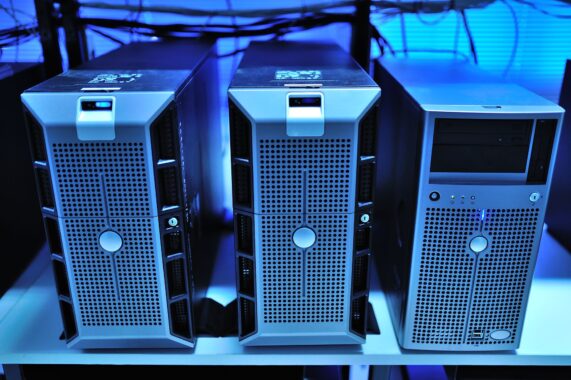
NVIDIA unveiled the DGX Spark HPC Developer Kit at the SC26 event in Chicago on November 16, 2026. The four-node desktop cluster is designed for scientific computing and AI development. The system comes with a total of 512 GB of memory and 20 TB of NVMe storage.
Four nodes and a switchless network
Each node in the kit is built around NVIDIA’s GB10 Grace Blackwell Superchip. The configuration scales from a single node up to four nodes. In the full setup, each system connects directly to its two neighbors over ConnectX-7 networking, forming a ring. This arrangement eliminates the need to buy and configure a separate network switch, while the total capacity makes it possible to distribute models and scientific workloads across the nodes.
NVIDIA says NVFP4 quantization supports running models with up to 700 billion parameters locally across four systems, citing DeepSeek V4.1 as an example. That expands the kit’s use cases from scientific simulation to large AI models.
HPC software and multi-node development
A setup guide for NVIDIA’s HPC SDK, the company’s scientific computing software development kit, has not been published yet; the company says it is coming soon. The guide will bring the GPU-accelerated C, C++, and Fortran compilers, libraries, and message-passing interface tools used on supercomputers to the cluster. The goal is to compile and test scientific applications across four nodes, examine how compute and data are distributed, and debug communication issues before teams scale up to larger systems.
Among the four-system workloads shown at the event were Kokkos-based LAMMPS for materials simulation and NAMD for molecular dynamics. NVIDIA also says the DGX Spark community has validated NIM microservices such as GROMACS for molecular dynamics, OpenFOAM for fluid dynamics, WRF for weather modeling, and OpenFold3 with Boltz-2 for biomolecular structure prediction.
Local research workflow and sales
For teams dealing with fixed compute allocations and server quotas, NVIDIA positions local multi-node access as a way to avoid waiting in the queue for every job. Development and debugging can be done independently, shared server time can be reserved for production runs, and unpublished results and organization-specific data do not leave the premises. NVIDIA also suggests agent-assisted workflows: preparing simulation inputs, launching runs, and summarizing results, while the scientist handles validation.
The kit is on display at SC26 and available for purchase. DGX Spark products and cables can be purchased through the NVIDIA Marketplace and OEM partners such as Acer, ASUS, Dell Technologies, GIGABYTE, H3C, HP, Lenovo, MSI, and xFusion. The biggest question mark at launch is still on the software side: the HPC SDK guide that will bring supercomputer development tools to the cluster has not been published yet.
Source: Unite.AI



Share your experience
Bir sorunun, farklı bir çözümün veya eklemek istediğin bir notun var mı? Giriş yapmadan da yazabilirsin.