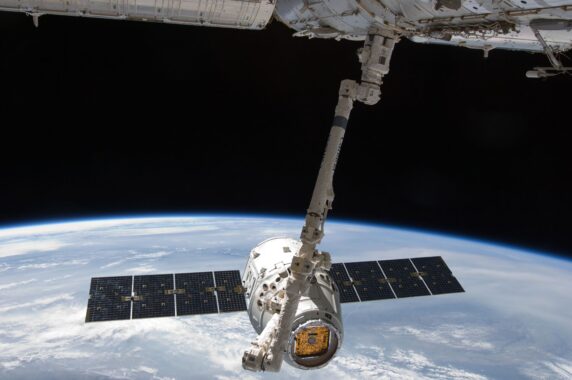
As AI models’ appetite for electricity grows, Google announced a project aiming to move data centers entirely off the Earth’s surface. Under the initiative, which the company calls Project Suncatcher, the first experimental computing satellite to operate in orbit will be sent to low Earth orbit (LEO) on October 1, 2026, aboard SpaceX’s Falcon 9 rocket on the Transporter-18 mission.
Built in partnership with Planet Labs and roughly the size of a refrigerator, the MVP (Minimum Viable Product) satellite will process Gemini queries directly in the space environment using the 4 Google Tensor Processing Units (TPUs) it carries. In other words, the goal is not for data to come down to Earth and be processed, but for the AI computation to be done in orbit and the result to return to Earth.
Why space
Google’s decision is not science fiction; it is based on economic and physical necessities. Building a new mega data center on Earth now takes years because of local residents’ objections to water consumption, bureaucratic permitting processes, and electricity demand that competes with nuclear power plants. Space, however, solves all three problems at once with a different equation:
- Solar power: Panels in low Earth orbit are not hindered by the atmosphere, clouds, dust, or the day-night cycle. According to the source, this means 8 times more electricity generation per square meter compared to Earth’s surface.
- Land and grid dependence: Grid infrastructure fees paid to electric distribution companies and years spent waiting in transformer queues are eliminated; the system consumes the energy it produces itself.
- Water consumption: The need for cooling towers that run on millions of liters of water drops to zero; heat is radiated into space through thermal radiation panels in vacuum.
Running Gemini in space
The MVP satellite is one of Google’s toughest tests yet for hardware engineering. While a data center on Earth has thousands of racks full of TPU v5p and v6e chips, grid electricity, liquid and evaporative cooling, and a fiber-optic network, the equivalent server capacity in orbit will run on 4 radiation-hardened TPUs, uninterrupted solar panels, thermal radiators operating in vacuum, and laser-based satellite-to-ground optical communication. The model being run will be lightened in the same way: instead of distributed massive Gemini models, a Gemini core optimized for the space environment will be used.
Radiation and heat management are the biggest obstacles
James Manyika, Google’s Senior Vice President for Research, says the project is exciting but faces serious engineering obstacles. The first problem is single-event upsets (SEUs) caused in chips by cosmic rays without the atmosphere’s protective shield. Google plans to overcome this with error-correcting codes (ECC) and lead-reinforced composite enclosures. The second obstacle is heat management in vacuum: in an environment where ventilation fans do not work, the processors’ heat must be carried to radiation panels on the outer surface via copper heat pipes.
The 2030s goal: an orbital computing fleet
According to Google’s long-term projection, as reusable rockets like Starship reduce launch costs per kilogram to tens of dollars, by the mid-2030s the operating cost of orbital data centers will reach break-even with facilities on Earth. The company aims to establish orbital clusters of 80 or more spacecraft connected to each other by laser networks. In this scenario, an AI query coming from anywhere in the world will reach orbit, be processed with solar power, and return.
What it means in the short term
The October 1 launch is not the start of a commercial service; it is a test of whether a 4-TPU experiment can survive in space. Whatever the result, the debate has already shifted: the AI race is not only about model quality, but an infrastructure struggle fought over electricity, water, and land. Google’s equation attempts to push the boundaries of that struggle beyond the planet.
Source: WebTuring
Share your experience
Bir sorunun, farklı bir çözümün veya eklemek istediğin bir notun var mı? Giriş yapmadan da yazabilirsin.