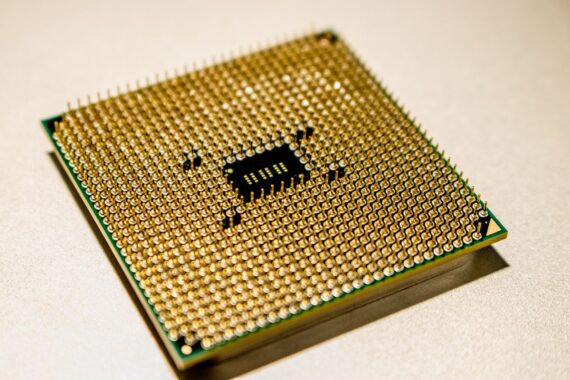
AMD made its sixth-generation EPYC SP7 server processors generally available on November 10. The ten-model Zen 6 family is positioned for servers running AI agents, GPU host nodes, and enterprise applications. Server makers have already started shipping systems, and cloud instances on Microsoft Azure and Oracle Cloud Infrastructure are also expected to go live soon.
From 64 cores to 256 cores
The EPYC 9006 SP7 series ranges from 64 to 256 cores and from 128 to 512 threads. Thanks to simultaneous multithreading, each core runs two threads. Zen 6 cores target AI host nodes that need high frequencies, while Zen 6c cores are aimed at denser agent execution. The platform also supports PCIe Gen 6.
At the top of the lineup are the EPYC 9996 and 9956, both with 1,024 MB of L3 cache. The 9996 runs at a 2.55 GHz base clock and 4.1 GHz turbo, with power consumption listed at 600 watts, configurable between 400 and 600 watts. The frequency-focused EPYC 9686F and 9586F can scale from a 4.05 GHz base clock up to 5.3 GHz.
AMD’s performance claims
AMD says it measured up to a 1.8x increase in language model throughput on GPU host nodes compared to the previous generation. That result comes from a comparison where model weights were moved to the CPU side; the measurement was taken over a PCIe Gen 5 link and extrapolated to Gen 6 bandwidth. The tests showed that the main bottleneck was the PCIe link, not main memory.
For agent sandboxes, the company estimates about 3.3x higher per-CPU watt efficiency than Nvidia Vera and 2.5x more agent capacity than Intel Xeon 6980P. However, this figure was not measured from a live deployment; it was derived by converting the current thread count into a workload based on shared assumptions. AMD also projects that, in a 35-kilowatt rack, lowering CPU and memory power limits by 15% would support about 1.18x more agents in an EPYC 9996 configuration, while average performance loss per server would stay around 1%. This estimate is based on separate tests conducted on fifth-generation EPYC.
Azure HDv2 preview and OpenAI
Microsoft opened registrations on November 10 for the preview of Azure HDv2 virtual machines based on sixth-generation EPYC. Each machine offers more than 500 physical Zen 6 cores, 3.8 TB of DDR5-8800 memory, 30 TB of PCIe Gen 5 NVMe storage, and 400 Gb Azure Boost networking. According to Microsoft, a single HDv2 machine can run about twice as many agent sandboxes in parallel as the best alternative on the market and deliver up to 1.7x higher throughput on agent tasks. The company is still labeling these measurements as preliminary results.
Rafael Dietrich, who is responsible for CPU and storage capacity planning at OpenAI, says that when preparing large datasets, having more cores makes it possible to split the work into more pieces. According to him, the same balance applies in scenarios where large numbers of coding agents are compiling software and running tests at the same time. When it becomes generally available, HDv2 will also be offered on partner platforms such as Rescale and Synopsys, alongside Azure Kubernetes Service, Azure Databricks, and Azure CycleCloud.
AMD’s announcement looks at agent capacity not just in terms of accelerator count, but together with core density, memory, and rack power budget. The real test will be how many concurrent agents can be sustained within a fixed power limit without leaving GPUs idle.
Source: Unite.AI

Share your experience
Bir sorunun, farklı bir çözümün veya eklemek istediğin bir notun var mı? Giriş yapmadan da yazabilirsin.