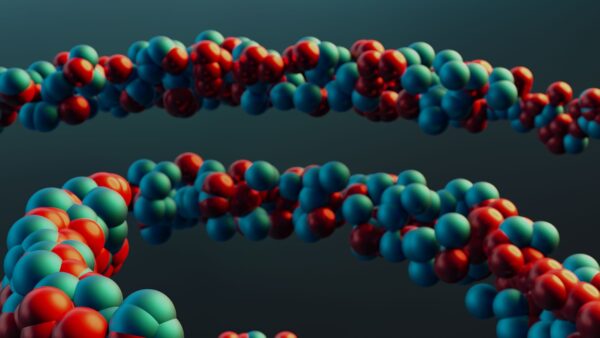
OpenAI announced that its GPT-6 family can design protein structures and amino acid sequences. The company shared lab results showing that its model, which uses reasoning and general-purpose coding tools, can independently handle tasks normally left to specialized protein systems. In a study conducted with research partner Onava, some proteins based on GPT-6.2 designs showed signs of binding to five targets.
Protein design in natural language
Traditionally, each protein-design task requires its own specialized system. These systems work with specific inputs; when a new requirement comes along, the software has to be changed or the system trained further. OpenAI, by contrast, describes in natural language where small proteins called minibinders should bind, what structural class they should belong to, and how many helices or sheets they should contain.
In the first lab experiment, the pre-release version of GPT-6.2 was given the three-dimensional structures of target proteins, with the desired binding sites marked. The model wrote code to generate candidate shapes without relying on specialized protein models. SolubleMPNN then proposed amino acid sequences, and other specialized systems filtered for candidates predicted to fold correctly, allowing Onava to test them.
Early binding results
The results are modest: 35 of the 322 minibinders tested—10.9%—showed signs of binding, with at least one success for each target. OpenAI also notes that earlier RFdiffusion experiments achieved higher rates, and that comparisons depend heavily on the filtering process and how binding is defined.
In antibody experiments, 128 of 182 loop designs—70%—showed binding across six small VHH antibodies targeting IL-4Rα. Of the 272 fragments derived from five therapeutic antibodies, 179—66%—bound to their original PD-1 or PD-L1 targets.
Specialized models are still needed
Overall protein structure prediction remains the weakest point. GPT-6.2 has an average TM-score of 0.26, while ESMFold2 reaches 0.93; scores above 0.5 generally indicate correct folding. So the study does not prove that GPT models can produce minibinders end to end without expert assistance.
Binding is only the first requirement. A useful research tool or drug also needs specificity, stability, and biological activity. OpenAI lists more challenging targets, selectivity and manufacturability, RNA and small molecules, and biosecurity risks related to potential misuse among the next steps.
Source: Unite.AI

Share your experience
Bir sorunun, farklı bir çözümün veya eklemek istediğin bir notun var mı? Giriş yapmadan da yazabilirsin.